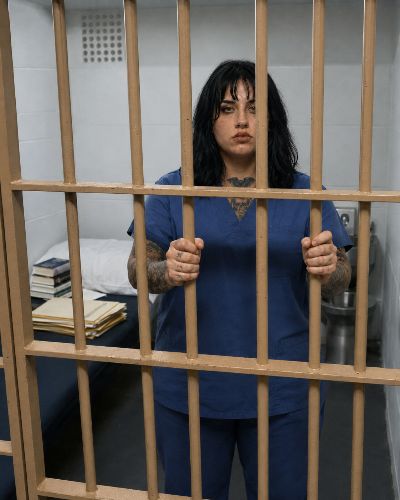
Delaney, Mara Victoria

Inmate ID: #RCK75128
Classification: Correctional
Rockville Penitentiary

Inmate Status
Demographic Data
First Name Mara
Middle Name Victoria
Last Name Delaney
Date of Birth 1994-05-09
Age 32 Years
Birthplace Pensacola, Florida
Race / Ethnicity White
Gender Female
Height 5'4"
Weight 170
Eye Color Brown
Convictions / Penalties
Code Offense Penalty Details Date Sentenced
Count #1
07-19SN5K
1st Degree Murder Death Penalty
Electric Chair
No Date Scheduled
2024-02-14
Age at sentencing: 29
Count #2
07-19SN5K
1st Degree Murder Death Penalty
Electric Chair
No Date Scheduled
2023-11-19
Age at sentencing: 29
Count #3
07-19SN5K
1st Degree Murder Death Penalty
Electric Chair
No Date Scheduled
2023-11-19
Age at sentencing: 29
Count #4
07-19SN5K
1st Degree Murder Death Penalty
Electric Chair
No Date Scheduled
2023-11-07
Age at sentencing: 29
  • 1st Degree Murder
    Count #1
    Code: 07-19SN5K
    2024-02-14
    Age at sentencing: 29
    Death Penalty
    Electric Chair
    No Date Scheduled
  • 1st Degree Murder
    Count #2
    Code: 07-19SN5K
    2023-11-19
    Age at sentencing: 29
    Death Penalty
    Electric Chair
    No Date Scheduled
  • 1st Degree Murder
    Count #3
    Code: 07-19SN5K
    2023-11-19
    Age at sentencing: 29
    Death Penalty
    Electric Chair
    No Date Scheduled
  • 1st Degree Murder
    Count #4
    Code: 07-19SN5K
    2023-11-07
    Age at sentencing: 29
    Death Penalty
    Electric Chair
    No Date Scheduled
Case Files:

No public case files mapped to this archive profile.

Summary

Mara Delaney always had an interest in the macabre. Following her arrest, unsent love letters to several (deceased) serial killers were posted online and independently verified to be her work. Furthermore, at her trial, prosecutors presented what amounted to a blog where she wrote fan fiction where she was coupled with these same serial killers. She wrote in this blog, anonymously from 19 until shortly before her arrest at 27. Despite these predilections, Ms. Delaney had a rather ordinary upbringing. She grew up quite wealthy, born into an upper middle-class family of lawyers in Pensacola, Florida. Her family would fund her education, where she studied criminology. She majored in it as an undergraduate and then, sought her PhD in it at Tampa State University. Unlike her colleagues, many of whom had already pursued a career in law enforcement, Ms. Delaney was always what her peers called "alternative." She sported tattoos and revealing clothing which many complained were "inappropriate." However, she was considered a gifted student, possibly one of the most gifted in her class. Nearing her graduation in 2022, she was in the final stages for a job at the FBI, which would ultimately prove to be her undoing. The extended background check linked her to an unsolved triple murder case at North Florida College, a small liberal arts school some distance away from Tampa. On May 2021, three Co-eds (Lisa Hanley, 19, Georgia Davies, 20 and Cara Hanley 18) were killed when someone broke into their off-campus house and killed each of them with a knife. The story horrified the public and made national news, but no preparator was found. The police thought it was a previously unknown serial killer due to the precision and lack of mistakes that the killer made in their work. However, it turned out that Ms. Delaney used her seeming genius in criminology to commit what appeared to be the perfect crime. However, her extensive background check revealed to the FBI a digital footprint that made her a prime suspect. On May 14th, 2022, days before her graduation, the FBI arrested her for three counts of first-degree murder. They found the murder weapon in the search of her apartment, which she had kept as a memento from the crime. As the feds had her dead to rights, her high powered defense attorney managed to get her a deal to spare her the electric chair. Life without the possibility of parole. A full confession, not only of the three murders, but a fourth which she committed as "practice." The remains of this victim had yet to be found so Ms. Delaney's attorneys leveraged this to get the deal. However, with seeming immunity, Ms. Delaney seemed unburdened and began "sharing" her exploits. At one point, she even smuggled a phone into prison and started a short lived tiktok account where she bragged about her crimes, even going as far as talking about the NFU co-ed's final moments. This brought on national outrage, but Ms. Delaney did not seem to care until sentencing. At sentencing, the judge decided that her deal was forfeit as a result of Ms. Delaney's actions. He saw no other choice, but impose a death sentence on her, sending her to Rockville to face its electric chair. Ms. Delaney proceeded to freak out in the courtyard, cursing out the judge and saying that she could not do this to her. That they could not send her to the chair. They had a deal.

News Articles / Stories
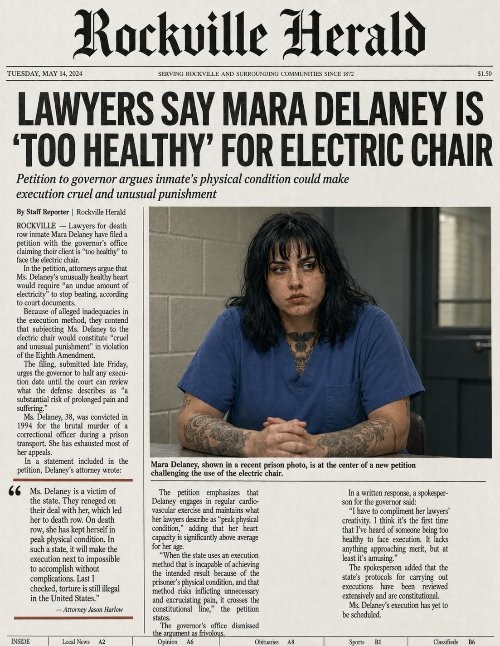
Article Thumbnail
Behind The Glass

Aug 14, 2026 • Jasondern12

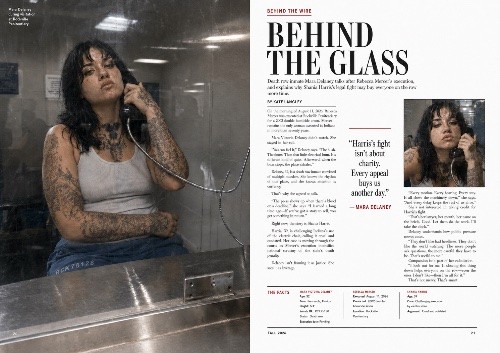
Death-row inmate Mara Delaney talks after Rebecca Mercer’s execution—and explains why Shania Harris’s legal fight matters to the woman who freely admits she is looking out for herself.By Kate LangleyPhotographs taken during an unauthorized visitation at Rockville Penitentiary.Photo caption: Mara Victoria Delaney, 32, photographed through the scratched partition of a visitation booth at Rockville Penitentiary. Delaney is awaiting an execution date.Mara Delaney did not watch Rebecca Mercer die.On the morning of August 11, while Mercer was being prepared for the electric chair elsewhere inside Rockville Penitentiary, Delaney remained locked in her cell.She says she preferred it that way.“I didn’t need a front-row seat,” she tells me through the visitation glass several days later. “You know what’s happening. Everybody knows.”Delaney lifts the black telephone receiver away from her ear for a moment, studying her reflection in the scratched glass between us. Fluorescent lights ripple across her face. Someone has apparently told her that photographs are being taken. She does not appear particularly concerned about the rules.“You hear the building change,” she continues. “That’s the part people outside don’t understand. Doors are different. Officers are different. Nobody wants to be the idiot laughing too loud.”Mercer, 58, was executed at Rockville for the 2002 arson deaths of her former husband and his girlfriend. Prison officials said she remained composed during her final hours and apologized to the victims’ families before her sentence was carried out.Delaney says she knew most of those details before reporters did.That is characteristic of her.At 32, the Pensacola native has spent much of her adult life studying crime—first academically and then from the opposite side of the bars. She studied criminology before her arrest and once appeared headed toward a professional career in the field. Instead, she is now on death row after convictions for multiple first-degree murders.Her prison identification number, RCK75128, is stenciled on the blue pants she wears to visitation.When I ask whether Mercer’s execution frightened her, Delaney rolls her eyes.“Is that the quote you want?”It is the first flash of what people who know her describe as Delaney’s defining quality: an almost adolescent irritation at being expected to display the correct emotion.“I’m not going to sit here and give you some trembling little speech about how Rebecca dying changed my soul,” she says. “It didn’t.”A pause.“It changed my math.”That distinction matters to Delaney.She does not claim to have been close to Mercer. She does not romanticize the dead woman, nor does she offer much sympathy. What interests her is the machinery surrounding Mercer’s death—the appeals that ended, the timetable that accelerated, the security measures that tightened, and what all of it might mean for the women whose names remain on the list.Especially her own.“Mercer proved they’re willing to actually do it,” Delaney says. “Okay. Useful information.”Useful.It is a word she returns to repeatedly.Publicity is useful. Legal controversy is useful. Reporters are useful. Even another inmate’s terror, provided it produces litigation, can be useful.Which brings us to Shania Harris.Harris, 39, is challenging the use of the electric chair as her final appeals near resolution. Her attorneys argue that electrocution is cruel and outdated, and they have pointed to renewed scrutiny surrounding Mercer’s execution as part of the reason courts should reconsider the method.Delaney is following the challenge closely.Not, she emphasizes, because she and Harris are friends.“Please,” she says, drawing the word out. “We’d annoy each other in ten minutes.”Then why care?“Because her lawyers are making noise.”Delaney leans closer to the glass.“Every motion. Every hearing. Every stay. Every newspaper story where somebody has to explain why they’re still using that chair. That slows things down.”She smiles for the first time.“And slow is good.”“Harris’s fight isn’t about charity. Every appeal buys us another day.” — Mara DelaneyDelaney makes no effort to dress this position up as solidarity.“If Harris wins something, great. If the state has to change procedures, great. If they spend six months arguing over paperwork, even better.”She shrugs.“I’ll take the clock.”There is something almost bratty in the delivery, an insistence that any attempt to impose a moral framework on her thinking is simply tedious.Asked whether she worries that speaking so casually might make the public less sympathetic to her, Delaney laughs.“You think I had them before?”She has a point.Details of Delaney’s case, including her fascination with the macabre and writings uncovered after her arrest, have made her an unusually easy figure for the public to despise. Her intelligence—once directed toward criminology—has also fueled the image of a woman who understood criminal investigation well enough to believe she could outsmart it.Delaney is aware of that image.At times, she appears to enjoy it.At others, she appears to be calculating exactly how much it costs her.“People are going to call me whatever they want,” she says. “Monster. Psycho. Princess. I’ve heard better.”Princess?Another smile.“Apparently I’m demanding.”According to Delaney, asking officers to replace a damaged paperback and complaining about cold coffee have both been cited by other inmates as evidence of her supposed entitlement.“You get sentenced to die and suddenly wanting coffee that isn’t disgusting is a character flaw.”The smirk returns.“Very dramatic.”Yet beneath the performance, Mercer’s execution has changed something.Delaney no longer talks about execution entirely in abstractions.She talks about sequence.Mercer first.Possibly Harris next.Then someone else.Eventually, perhaps, her.She does not say that last part.Not yet.CONTINUED: THE WOMAN THE PUBLIC WANTS PUNISHEDThere is a complication in Delaney’s attempt to turn public attention into leverage.Much of the public does not want the machinery slowed.They want it accelerated.Letters to the editor, online comments and public reaction to high-profile capital cases frequently contain the same argument: whatever objections may exist to the death penalty in theory, inmates convicted of crimes like Delaney’s are precisely the people for whom the harshest punishment was intended.When I read one such sentiment aloud, Delaney’s expression changes.The smirk disappears.The telephone cord creaks as she tightens her grip on the receiver.“So that’s the angle now?”I tell her it is not an angle. It is a question.She looks away.For several seconds, the only thing visible in the scratched glass is the reflection of a fluorescent tube crossing her cheek.Then she turns back.“People love saying that when it isn’t their body.”Her tone is sharper now.There are people, I tell her, who would hear everything she has said—the calculation, the lack of remorseful language, the willingness to exploit Harris’s fear for her own benefit—and conclude that she is making the argument for them.That Mara Delaney deserves the full penalty of the law.She is immediately angry.“Of course they do.”Her knee begins moving underneath the steel counter.“They get this little fantasy where they’re the judge and the jury and the executioner because they read three paragraphs online.”She says executioner with contempt.Then she catches herself.The anger retreats slightly.What replaces it is less comfortable.Nervousness.For the first time during the interview, Delaney asks exactly what will be printed.Not generally.Exactly.“Are you putting that sentence in there?”Which sentence?“The one about people saying I deserve it.”Probably.Her jaw tightens.“Cute.”The word lands without humor.Until now, Delaney has treated attention as something she can manipulate. Print her name. Discuss the chair. Question the process. Create friction. Friction creates delay.But attention can move in both directions.A story can produce scrutiny of the execution process.It can also remind readers why a particular prisoner was sentenced to death in the first place.Delaney knows that.And she hates it.“I’m not asking anybody to like me,” she says.Her voice is lower now.“I’m saying the government shouldn’t get to screw up because they decided somebody’s unpopular enough that nobody will care.”That is the closest she comes to a principled argument.Then, almost reflexively, she ruins the moment.“And yes, obviously I have a personal interest in them not killing me. Congratulations on cracking the case.”The sarcasm is back.But not completely.I ask whether Mercer’s execution made her think about her own.“No.”Too fast.I wait.Delaney stares through the glass.“No,” she repeats.Her fingers tap once against the receiver.Twice.Then:“I think about my appeals.”That is not what I asked.“I know.”She looks irritated now, but the irritation feels defensive rather than theatrical.“What do you want me to say? That I picture the chair every night? That I wake up screaming?”Do you?“No.”Another pause.“Not every night.”It is the first answer she appears to regret.She shifts immediately into attack.“That better not be your headline.”The woman who has spent most of the interview insisting that publicity is currency suddenly looks like someone discovering that currencies fluctuate.She asks again what the headline will be.She wants to know whether the photographs make her look tired.She wants to know whether the story will mention the worst details of her crimes.She wants to know whether Harris’s attorneys might read it.Whether the governor might.Whether prosecutors might.Whether victims’ families might.The questions come too quickly for someone who supposedly does not care.“You people can make somebody look however you want,” she says.A few minutes earlier, she had been practically daring the camera to look at her.Now she turns her face slightly away from it.I ask the obvious question.Is she scared?Delaney gives me a look that would be vicious if the answer were not suddenly apparent.“I’m angry.”That was not the question.“I heard you.”Her eyes move toward the officer stationed beyond the visitation booths.Then back to me.“Fine. I don’t like not knowing.”Not knowing when?“Anything.”She gestures impatiently.“When Harris runs out of road. Who they sign for after her. Whether some judge decides the chair is fine because Mercer technically died on schedule.”Her voice drops.“When my name moves.”There it is.For all the swagger, Mara Delaney understands the list.She understands that every execution removes one name above hers.She understands that Mercer’s death was not merely an event but a vacancy.And she understands something else that makes her visibly furious:There are people outside Rockville who will celebrate when the vacancy is eventually hers.“You know what I hate?” she says.“What?”“They think wanting me dead means they’re better than me.”She leans toward the glass again.“Maybe they are. Maybe they aren’t. But they don’t get to pretend they’re disgusted by violence while counting down to mine.”It is an unexpectedly serious line.Then Delaney spoils it with a crooked smile.“Print that one. Makes me sound deep.”The receiver clicks against the glass as she shifts it to her other hand.The brat is back.Mostly.But her knee is still bouncing beneath the table.
Article Thumbnail
CRIMINOLOGY STUDENT SENTENCED TO DEATH IN NORTH FLORIDA COLLEGE MURDERS

Aug 14, 2026 • aelectricstars

Mara Delaney transferred to Rockville Penitentiary after judge throws out controversial plea agreementTAMPA, Fla. — Mara Delaney, the 32-year-old criminology prodigy whose arrest stunned Florida and brought an apparent end to one of the state's most notorious unsolved murder cases, has been transferred to the death row unit at Rockville Penitentiary after being sentenced to death.Delaney was convicted in connection with the brutal 2021 murders of three students attending North Florida College: Lisa Hanley, 19; Georgia Davies, 20; and Cara Hanley, 18.The three young women were found dead inside the off-campus house they shared in May 2021. Each had been killed with a knife after an intruder apparently entered the residence.The killings horrified the small college community and quickly became national news.What particularly troubled investigators was what they did not find.Police reported few of the mistakes typically associated with a violent crime scene. Investigators initially theorized that the killings could have been committed by an experienced offender or previously unidentified serial killer.For nearly a year, the case remained unsolved.Then investigators began looking at Mara Delaney.A DIGITAL TRAIL BREAKS THE CASEDelaney had attracted attention for her academic abilities and extensive knowledge of criminology. According to investigators, those same skills may have helped her construct a crime deliberately intended to frustrate police.But the physical crime scene wasn't ultimately what led authorities to her.An extensive background investigation uncovered what federal investigators described as a digital footprint connecting Delaney to the victims, their residence and circumstances surrounding the murders.As investigators reconstructed Delaney's online activity, movements and history, she went from an obscure name in a background check to the primary suspect in the case.On May 14, 2022, just days before she was expected to graduate, FBI agents arrested Delaney on three counts of first-degree murder.A subsequent search of her apartment produced the discovery prosecutors had been hoping for.The suspected murder weapon was still in her possession.Authorities alleged that Delaney had kept the knife as a personal memento of the killings.The discovery effectively shattered any remaining notion of a "perfect crime."A FOURTH VICTIMFacing overwhelming evidence and the possibility of execution, Delaney's attorneys negotiated an extraordinary agreement with prosecutors.Delaney would receive life imprisonment without the possibility of parole rather than face the electric chair.In return, she would provide a complete confession.That confession contained another bombshell.Delaney admitted responsibility not only for the North Florida College murders but for a previously unknown fourth killing that she reportedly described as "practice."The identity of that victim and the location of the victim's remains remained unknown.Delaney's knowledge of the undiscovered crime gave her attorneys considerable leverage. Investigators wanted answers, particularly information that could allow another family to finally learn what happened to their missing loved one.The agreement appeared to guarantee that Delaney would spend the remainder of her life behind bars.What happened next changed everything.PRISON VIDEOS SPARK NATIONAL OUTRAGEOnce incarcerated and seemingly protected from execution by her agreement, Delaney's behavior reportedly changed.She began openly discussing the murders.Then prison officials discovered something extraordinary: Delaney had obtained a contraband cellphone.Using the device, she created a short-lived TikTok account from inside prison.Rather than proclaiming her innocence, Delaney reportedly used the account to discuss and brag about her crimes.Some of the videos went considerably further.Delaney allegedly described details surrounding the final moments of the North Florida College victims, turning the deaths of three young women into material for an online audience.The videos spread before the account could be removed.Public reaction was immediate.Victims' advocates and members of the community condemned the posts, while relatives of the murdered students were forced to watch details of their loved ones' deaths circulate online.The controversy eventually reached the courtroom."WE HAD A DEAL"At Delaney's sentencing hearing, the confident demeanor observers had seen following her plea agreement reportedly disappeared.The presiding judge determined that Delaney's conduct had violated the conditions upon which the agreement had been reached and declared the deal forfeited.The court then imposed the sentence Delaney believed she had escaped:Death.Witnesses described an immediate emotional outburst.Delaney began shouting and cursing at the court, insisting that prosecutors had made an agreement with her and that she could not legally be sent to the electric chair.She reportedly screamed repeatedly that "we had a deal" as officers attempted to regain control of the courtroom.It was a striking reversal for a defendant who had appeared remarkably composed while discussing crimes that had horrified the country.TRANSFERRED TO ROCKVILLEDelaney has now been transferred under heavy security to Rockville Penitentiary, where she has been processed into the Department of Corrections' death row unit.Her inmate identification number is RCK1994.Instead of serving a life sentence in the general prison population, Delaney will now live under the substantially tighter restrictions imposed on condemned prisoners.The transfer does not mean an execution is imminent.Delaney's attorneys will have the opportunity to challenge both her conviction and death sentence through the appeals process. Death-penalty litigation can continue through multiple state and federal courts before a sentence is ultimately carried out.No execution date has been established.For now, Delaney will remain on Rockville's death row while those appeals proceed.If they fail, state officials could eventually set an execution date, bringing Delaney face-to-face with the punishment she reportedly feared most during sentencing:Rockville Penitentiary's electric chair.For the families of Lisa Hanley, Georgia Davies and Cara Hanley, however, the legal battle surrounding Mara Delaney is only the latest chapter in a case that began with three college students murdered inside their home—and expanded into the disturbing story of a criminology student accused of using her knowledge of criminal investigation to try to get away with murder.
Photographic Records

No images have been uploaded to these photographic records yet.

INMATE COMMUNICATIONS KIOSK
Electronic Messaging System

Connect with this inmate through our secure electronic kiosk.

Log In to Send Message
Don't have an account? Sign up here
Comments
Log in to post a comment.
Loading...
For inquiries and reporting abusive use of the site please email .