
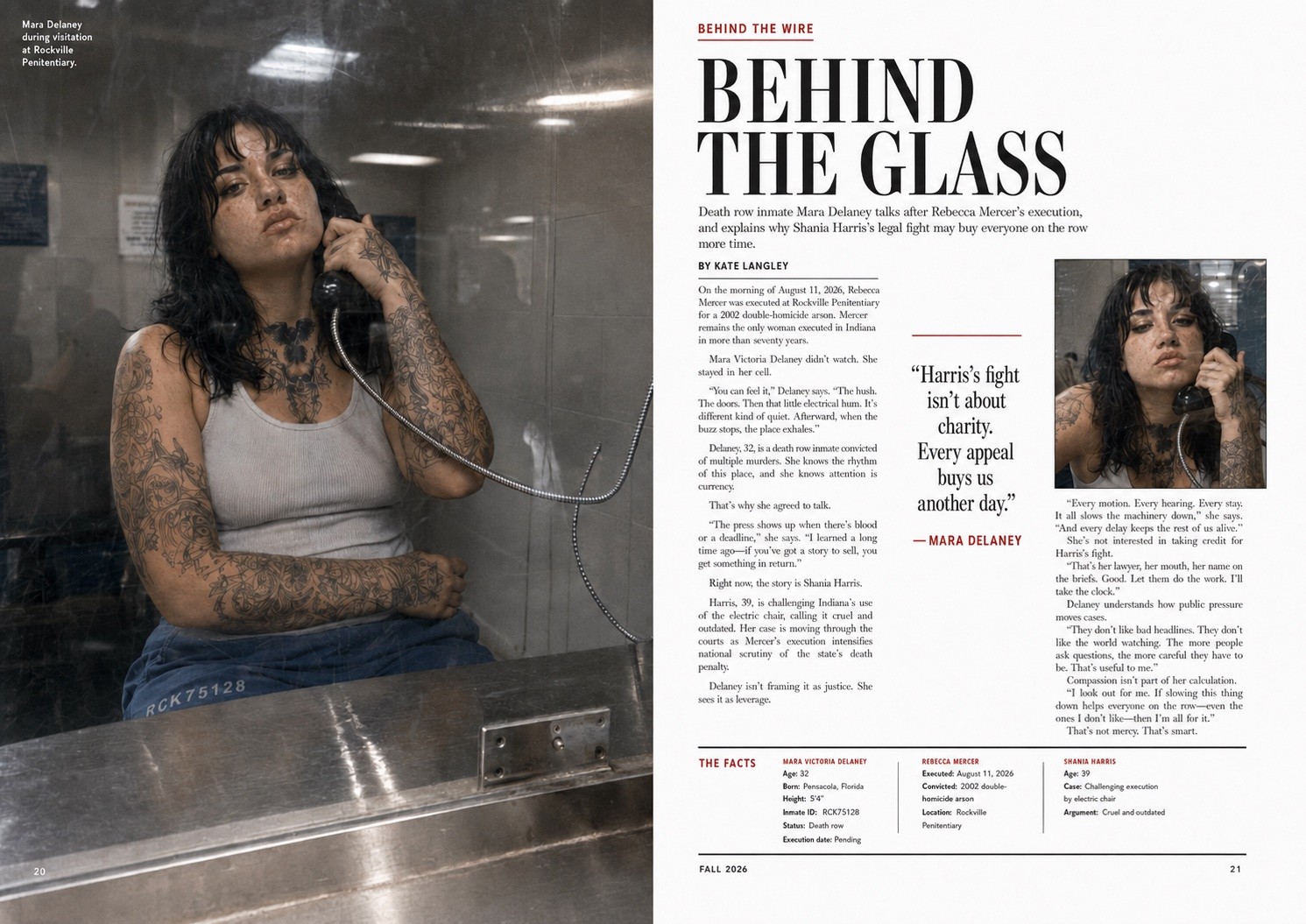
Death-row inmate Mara Delaney talks after Rebecca Mercer’s execution—and explains why Shania Harris’s legal fight matters to the woman who freely admits she is looking out for herself.
By Kate Langley
Photographs taken during an unauthorized visitation at Rockville Penitentiary.
Photo caption: Mara Victoria Delaney, 32, photographed through the scratched partition of a visitation booth at Rockville Penitentiary. Delaney is awaiting an execution date.
Mara Delaney did not watch Rebecca Mercer die.
On the morning of August 11, while Mercer was being prepared for the electric chair elsewhere inside Rockville Penitentiary, Delaney remained locked in her cell.
She says she preferred it that way.
“I didn’t need a front-row seat,” she tells me through the visitation glass several days later.
“You know what’s happening. Everybody knows.”
Delaney lifts the black telephone receiver away from her ear for a moment, studying her reflection in the scratched glass between us. Fluorescent lights ripple across her face. Someone has apparently told her that photographs are being taken. She does not appear particularly concerned about the rules.
“You hear the building change,” she continues. “That’s the part people outside don’t understand. Doors are different. Officers are different. Nobody wants to be the idiot laughing too loud.”
Mercer, 58, was executed at Rockville for the 2002 arson deaths of her former husband and his girlfriend. Prison officials said she remained composed during her final hours and apologized to the victims’ families before her sentence was carried out.
Delaney says she knew most of those details before reporters did.
That is characteristic of her.
At 32, the Pensacola native has spent much of her adult life studying crime—first academically and then from the opposite side of the bars. She studied criminology before her arrest and once appeared headed toward a professional career in the field. Instead, she is now on death row after convictions for multiple first-degree murders.
Her prison identification number, RCK75128, is stenciled on the blue pants she wears to visitation.
When I ask whether Mercer’s execution frightened her, Delaney rolls her eyes.
“Is that the quote you want?”
It is the first flash of what people who know her describe as Delaney’s defining quality: an almost adolescent irritation at being expected to display the correct emotion.
“I’m not going to sit here and give you some trembling little speech about how Rebecca dying changed my soul,” she says. “It didn’t.”
A pause.
“It changed my math.”
That distinction matters to Delaney.
She does not claim to have been close to Mercer. She does not romanticize the dead woman, nor does she offer much sympathy. What interests her is the machinery surrounding Mercer’s death—the appeals that ended, the timetable that accelerated, the security measures that tightened, and what all of it might mean for the women whose names remain on the list.
Especially her own.
“Mercer proved they’re willing to actually do it,” Delaney says. “Okay. Useful information.”
Useful.
It is a word she returns to repeatedly.
Publicity is useful. Legal controversy is useful. Reporters are useful. Even another inmate’s terror, provided it produces litigation, can be useful.
Which brings us to Shania Harris.
Harris, 39, is challenging the use of the electric chair as her final appeals near resolution. Her attorneys argue that electrocution is cruel and outdated, and they have pointed to renewed scrutiny surrounding Mercer’s execution as part of the reason courts should reconsider the method.
Delaney is following the challenge closely.
Not, she emphasizes, because she and Harris are friends.
“Please,” she says, drawing the word out. “We’d annoy each other in ten minutes.”
Then why care?
“Because her lawyers are making noise.”
Delaney leans closer to the glass.
“Every motion. Every hearing. Every stay. Every newspaper story where somebody has to explain why they’re still using that chair. That slows things down.”
She smiles for the first time.
“And slow is good.”
“Harris’s fight isn’t about charity. Every appeal buys us another day.” — Mara Delaney
Delaney makes no effort to dress this position up as solidarity.
“If Harris wins something, great. If the state has to change procedures, great. If they spend six months arguing over paperwork, even better.”
She shrugs.
“I’ll take the clock.”
There is something almost bratty in the delivery, an insistence that any attempt to impose a moral framework on her thinking is simply tedious.
Asked whether she worries that speaking so casually might make the public less sympathetic to her, Delaney laughs.
“You think I had them before?”
She has a point.
Details of Delaney’s case, including her fascination with the macabre and writings uncovered after her arrest, have made her an unusually easy figure for the public to despise. Her intelligence—once directed toward criminology—has also fueled the image of a woman who understood criminal investigation well enough to believe she could outsmart it.
Delaney is aware of that image.
At times, she appears to enjoy it.
At others, she appears to be calculating exactly how much it costs her.
“People are going to call me whatever they want,” she says. “Monster. Psycho. Princess. I’ve heard better.”
Princess?
Another smile.
“Apparently I’m demanding.”
According to Delaney, asking officers to replace a damaged paperback and complaining about cold coffee have both been cited by other inmates as evidence of her supposed entitlement.
“You get sentenced to die and suddenly wanting coffee that isn’t disgusting is a character flaw.”
The smirk returns.
“Very dramatic.”
Yet beneath the performance, Mercer’s execution has changed something.
Delaney no longer talks about execution entirely in abstractions.
She talks about sequence.
Mercer first.
Possibly Harris next.
Then someone else.
Eventually, perhaps, her.
She does not say that last part.
Not yet.
CONTINUED: THE WOMAN THE PUBLIC WANTS PUNISHED
There is a complication in Delaney’s attempt to turn public attention into leverage.
Much of the public does not want the machinery slowed.
They want it accelerated.
Letters to the editor, online comments and public reaction to high-profile capital cases frequently contain the same argument: whatever objections may exist to the death penalty in theory, inmates convicted of crimes like Delaney’s are precisely the people for whom the harshest punishment was intended.
When I read one such sentiment aloud, Delaney’s expression changes.
The smirk disappears.
The telephone cord creaks as she tightens her grip on the receiver.
“So that’s the angle now?”
I tell her it is not an angle. It is a question.
She looks away.
For several seconds, the only thing visible in the scratched glass is the reflection of a fluorescent tube crossing her cheek.
Then she turns back.
“People love saying that when it isn’t their body.”
Her tone is sharper now.
There are people, I tell her, who would hear everything she has said—the calculation, the lack of remorseful language, the willingness to exploit Harris’s fear for her own benefit—and conclude that she is making the argument for them.
That Mara Delaney deserves the full penalty of the law.
She is immediately angry.
“Of course they do.”
Her knee begins moving underneath the steel counter.
“They get this little fantasy where they’re the judge and the jury and the executioner because they read three paragraphs online.”
She says executioner with contempt.
Then she catches herself.
The anger retreats slightly.
What replaces it is less comfortable.
Nervousness.
For the first time during the interview, Delaney asks exactly what will be printed.
Not generally.
Exactly.
“Are you putting that sentence in there?”
Which sentence?
“The one about people saying I deserve it.”
Probably.
Her jaw tightens.
“Cute.”
The word lands without humor.
Until now, Delaney has treated attention as something she can manipulate. Print her name. Discuss the chair. Question the process. Create friction. Friction creates delay.
But attention can move in both directions.
A story can produce scrutiny of the execution process.
It can also remind readers why a particular prisoner was sentenced to death in the first place.
Delaney knows that.
And she hates it.
“I’m not asking anybody to like me,” she says.
Her voice is lower now.
“I’m saying the government shouldn’t get to screw up because they decided somebody’s unpopular enough that nobody will care.”
That is the closest she comes to a principled argument.
Then, almost reflexively, she ruins the moment.
“And yes, obviously I have a personal interest in them not killing me. Congratulations on cracking the case.”
The sarcasm is back.
But not completely.
I ask whether Mercer’s execution made her think about her own.
“No.”
Too fast.
I wait.
Delaney stares through the glass.
“No,” she repeats.
Her fingers tap once against the receiver.
Twice.
Then:
“I think about my appeals.”
That is not what I asked.
“I know.”
She looks irritated now, but the irritation feels defensive rather than theatrical.
“What do you want me to say? That I picture the chair every night? That I wake up screaming?”
Do you?
“No.”
Another pause.
“Not every night.”
It is the first answer she appears to regret.
She shifts immediately into attack.
“That better not be your headline.”
The woman who has spent most of the interview insisting that publicity is currency suddenly looks like someone discovering that currencies fluctuate.
She asks again what the headline will be.
She wants to know whether the photographs make her look tired.
She wants to know whether the story will mention the worst details of her crimes.
She wants to know whether Harris’s attorneys might read it.
Whether the governor might.
Whether prosecutors might.
Whether victims’ families might.
The questions come too quickly for someone who supposedly does not care.
“You people can make somebody look however you want,” she says.
A few minutes earlier, she had been practically daring the camera to look at her.
Now she turns her face slightly away from it.
I ask the obvious question.
Is she scared?
Delaney gives me a look that would be vicious if the answer were not suddenly apparent.
“I’m angry.”
That was not the question.
“I heard you.”
Her eyes move toward the officer stationed beyond the visitation booths.
Then back to me.
“Fine. I don’t like not knowing.”
Not knowing when?
“Anything.”
She gestures impatiently.
“When Harris runs out of road. Who they sign for after her. Whether some judge decides the chair is fine because Mercer technically died on schedule.”
Her voice drops.
“When my name moves.”
There it is.
For all the swagger, Mara Delaney understands the list.
She understands that every execution removes one name above hers.
She understands that Mercer’s death was not merely an event but a vacancy.
And she understands something else that makes her visibly furious:
There are people outside Rockville who will celebrate when the vacancy is eventually hers.
“You know what I hate?” she says.
“What?”
“They think wanting me dead means they’re better than me.”
She leans toward the glass again.
“Maybe they are. Maybe they aren’t. But they don’t get to pretend they’re disgusted by violence while counting down to mine.”
It is an unexpectedly serious line.
Then Delaney spoils it with a crooked smile.
“Print that one. Makes me sound deep.”
The receiver clicks against the glass as she shifts it to her other hand.
The brat is back.
Mostly.
But her knee is still bouncing beneath the table.