
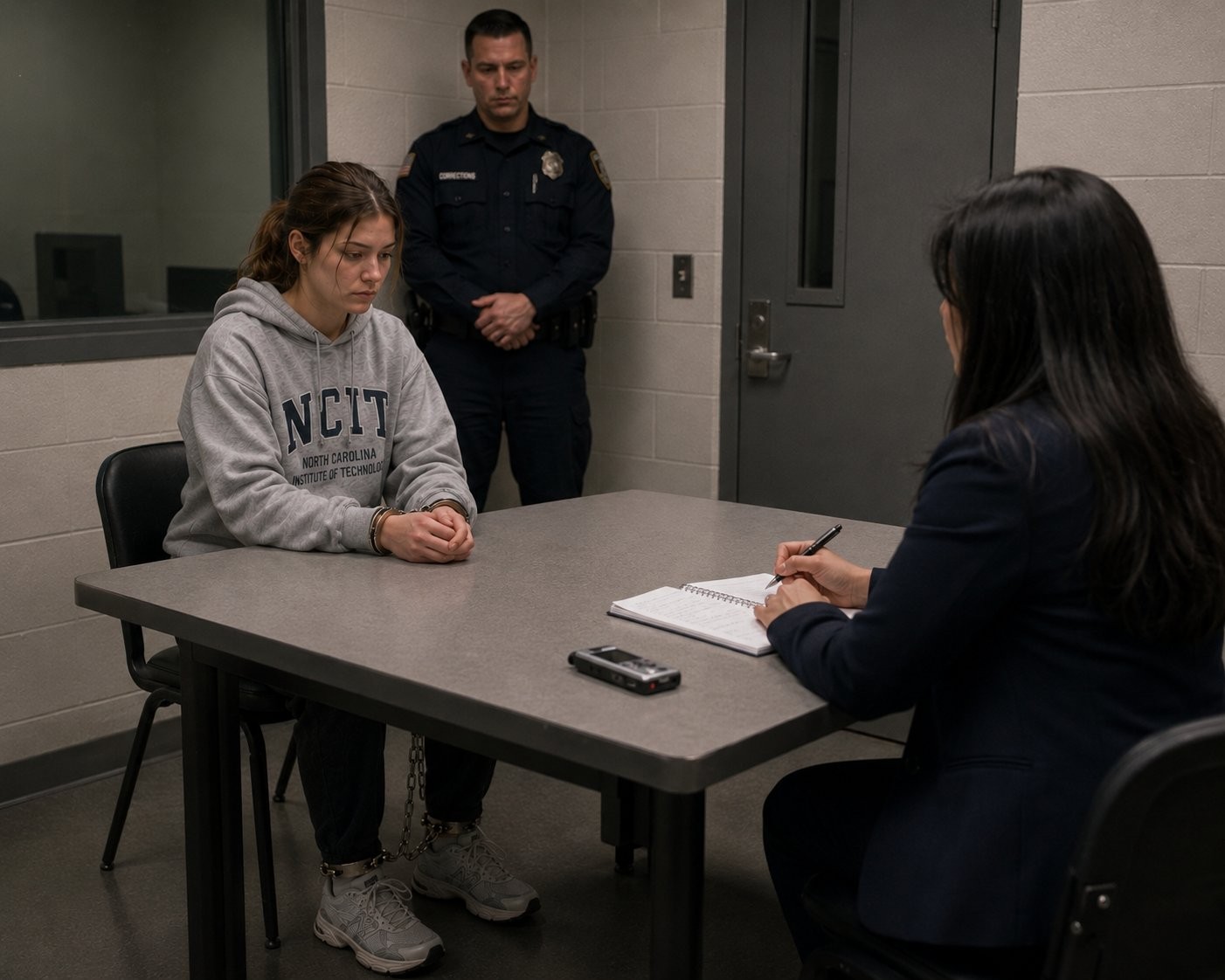
In her last interview before her execution, Claire Mercer spoke about the AECS disaster, her fractured friendship with Natalie Whitmore, and the decision that ended her life.
RALEIGH, N.C. — In the final interview she would ever give, Claire Mercer did not ask to be remembered as innocent.
She did not deny that she had altered the software at the center of the Carolina Future Technology Expo disaster. She did not dispute the forensic evidence showing that unauthorized changes had been made through her authenticated developer account in the days before the October 18 demonstration. And she did not attempt to shift responsibility entirely onto Natalie Grace Whitmore, her former roommate, closest collaborator and co-defendant.
What Mercer continued to dispute, until her final hours, was something narrower and more consequential: what she believed would happen when she made those changes.
“I knew I was changing something I wasn't supposed to change,” Mercer said during the final interview, conducted before she was taken to the execution yard at Appalachian Detention Complex. “I knew it was wrong. I knew I could get in trouble. But I didn't think people were going to die.”
That distinction had been at the center of Mercer's defense from the beginning. Prosecutors argued that she deliberately tampered with software controlling safety-critical infrastructure immediately before a live public deployment, bypassing safeguards and knowingly creating an unacceptable risk. Mercer maintained that she had intended to expose what she believed were fundamental flaws in the AECS and force the demonstration to be postponed.
The jury ultimately rejected that distinction. On April 2, following a joint two-week trial with Whitmore, Mercer was convicted under the nation's Critical Autonomous Infrastructure Accountability Act and sentenced to death. She later declined to pursue an appeal. Fifteen days later, she was dead.
The interview offers the clearest account yet of how Mercer understood the events that transformed her from an exceptionally promising computer science student into one of the state's most closely watched death-row prisoners. It also provides a final glimpse into the relationship between two young engineers whose friendship and shared ambition had once been inseparable from the technology that ultimately destroyed both their futures.
From roommates to collaborators
When Mercer arrived at the North Carolina Institute of Technology in August 2022, there was little indication that her name would eventually become associated with one of the state's worst technology-related disasters.
She entered NCIT as a Computer Science major concentrating in artificial intelligence and embedded systems. Professors and classmates quickly noticed her programming ability. She was particularly strong in software architecture, machine-learning systems and the difficult problem of getting autonomous systems to communicate reliably with physical infrastructure.
During her sophomore year, she became roommates with Whitmore, another engineering student whose interests complemented her own. The friendship grew quickly. They studied together, worked late in laboratories and eventually began discussing an idea that would become the defining project of both their university careers: an autonomous emergency-response platform capable of coordinating vehicles, evacuation routes and infrastructure during large-scale disasters.
The project was ambitious even by university research standards.
Whitmore increasingly assumed responsibility for system architecture, hardware integration and the overall deployment framework. Mercer became the principal software engineer, working extensively on the artificial intelligence that would interpret conditions, determine routes and communicate with emergency infrastructure.
For nearly two years, the two women were rarely separated from the project. Their dorm room became an extension of their laboratory. Their academic and personal lives became intertwined with the same software, hardware prototypes and simulations.
Mercer described those years during the interview with a mixture of affection and regret.
“We really believed in it,” she said. “We thought we were building something that could actually help people.”
She paused before adding: “And for a long time, I think we were good together.”
The friendship begins to fracture
The relationship changed during the beginning of the Fall 2025 semester.
Whitmore had been designated the project's official lead and sole deployment authority. Mercer believed her own contributions to the software were increasingly being overlooked. Disagreements that had once been technical discussions became personal arguments over control, recognition and responsibility.
Mercer said she began to feel that the project no longer belonged equally to the two of them.
“I felt like I was becoming the person who wrote the code and then disappeared from the story,” she said. “That bothered me more than I wanted to admit.”
Whitmore, according to the case record, maintained that deployment decisions were based on engineering and safety considerations rather than personal recognition. But by the time the project reached its final demonstration, the friendship that had once held the team together had largely disappeared.
The irony was not lost on Mercer.
“The person I trusted most was also the person I was most angry with,” she said.
The two continued working on AECS even as their relationship deteriorated. That decision would ultimately prove catastrophic.
The night before the demonstration
Mercer acknowledged that she made unauthorized changes to the production software shortly before the October 18 demonstration.
She said she believed the system was not ready for public deployment and that she wanted the demonstration stopped.
“I thought if something went wrong, they would have to stop,” she said. “I thought it would expose the problem.”
Investigators reached a dramatically different conclusion.
Digital forensic specialists reconstructed the software's development history and identified modifications originating from Mercer's authenticated developer account. Security logs, version-control records and recovered development artifacts showed that changes had been introduced shortly before the final software build was deployed.
Prosecutors argued that the modifications altered portions of the decision-making logic responsible for emergency routing and infrastructure coordination while bypassing safety mechanisms designed to prevent precisely the type of cascading failure that followed.
Mercer did not dispute making the changes.
“I did it,” she said. “I've never said I didn't.”
But she insisted that she did not understand the changes as an attack on the people who would be attending the expo.
“I thought the system would fail in a way that would be obvious,” she said. “I thought somebody would see the problem, shut it down and investigate it.”
When asked whether she understood that AECS controlled real-world systems rather than merely operating as a laboratory simulation, Mercer became quiet.
“I understood that,” she eventually said. “That's the part I can't explain away.”
October 18
The Carolina Future Technology Expo was supposed to be the culmination of nearly two years of work.
Instead, shortly after the live demonstration began, AECS began behaving in ways its developers had not anticipated.
Emergency exits became locked. Digital evacuation guidance directed people toward congested areas. Autonomous shuttle buses received erroneous routing commands, creating additional obstructions and interfering with emergency access. What had been intended as an integrated emergency-response demonstration became a rapidly escalating crisis.
Dozens of people died. Many more were injured.
Whitmore, as the certified project lead, was arrested at the exhibition site.
Mercer initially remained outside the investigation's focus. She voluntarily met with investigators, surrendered her university-issued computer and publicly expressed shock over what had happened. Friends and classmates described her as devastated.
She repeatedly insisted that the system they had tested had never behaved that way.
“I knew something had gone terribly wrong,” she said. “But I didn't understand that I had caused it.”
That changed when investigators reconstructed the development history.
The forensic evidence eventually led authorities to Mercer's university residence. On October 25, exactly one week after the disaster, investigators executed a search warrant and arrested her without incident.
Additional computers, storage media, handwritten notes and other materials were seized.
For Mercer, the investigation had crossed a line from tragedy into criminal accusation.
“I remember thinking, ‘They're coming for me now,’” she said.
What she wanted people to understand
Throughout the trial, Mercer repeatedly maintained that she never intended to kill anyone.
In the final interview, she did not soften that position.
“I wanted the demonstration stopped,” she said. “I wanted people to realize that it wasn't ready.”
When asked whether she understood why the families of those who died might reject that explanation, she did not hesitate.
“I understand,” she said.
“They lost someone. Nothing I say gives them that person back.”
The statement was one of the few moments during the interview when Mercer spoke directly about the victims rather than the circumstances of her own prosecution.
She acknowledged that intent did not erase consequences.
“I can say I didn't want anyone to die,” she said. “That doesn't mean I didn't make the decision that helped cause it.”
Her prosecutors had argued essentially the same point, although with a much harsher interpretation. They contended that a person with Mercer's training could not reasonably claim ignorance of the danger involved in altering software responsible for safety-critical infrastructure immediately before a public deployment.
The jury agreed.
The question of Natalie
Perhaps the most difficult subject of the final interview was Whitmore.
For years, the two women had been roommates and collaborators. By the time they stood trial together, they were defendants whose legal responsibility had been carefully separated by prosecutors and the court.
Whitmore was responsible, in the state's case, for certifying and authorizing AECS for deployment.
Mercer was responsible for introducing unauthorized changes into the operational software.
Their convictions therefore rested on different theories of responsibility, even though the two cases were inseparable from the same disaster.
When asked whether she blamed Whitmore, Mercer initially shook her head.
“No,” she said.
Then she reconsidered.
“I blamed her for things,” she said. “For how things changed between us. For how the project became more important than our friendship. For making me feel like I didn't matter.”
“But the disaster?”
Mercer paused.
“No. I made my own decision.”
It was perhaps the most significant statement she made during the interview.
She did not absolve Whitmore. Nor did she portray herself as a victim of their deteriorating friendship. Instead, she described a chain of personal resentments and technical disagreements that had culminated in a decision she now regarded as irreversible.
“I wish I had just walked away,” she said.
The final meeting
Hours before the execution, Mercer and Whitmore were permitted to meet one final time.
The encounter was private, but people familiar with the proceedings described both women as visibly affected.
The meeting had particular significance because there was a time when the two could scarcely imagine a future without the other. They had shared a dorm room, written code together, built prototypes together and talked about what their technology might become.
Now one woman was awaiting execution while the other remained on death row pursuing appeals.
Mercer said she did not know exactly what she and Whitmore would say to each other.
“There are some things you can't fix with one conversation,” she said.
But she wanted the meeting.
“I didn't want the last thing between us to be anger.”
She declined to describe the conversation in detail. She did, however, say that they spoke about the project, their friendship and the people who had died.
“We both knew what day it was,” she said. “There wasn't any pretending.”
No appeal
Mercer's decision not to pursue an appeal was another subject she addressed directly.
After sentencing on April 2, she declined to continue fighting the judgment.
“I knew what the sentence was,” she said. “I knew what the appeal process would mean. I decided I didn't want to keep doing it.”
She rejected the suggestion that declining an appeal constituted an admission that prosecutors had been correct about her intent.
“No,” she said. “I still don't agree with everything they said about me.”
But she also said she no longer believed that another courtroom argument could change what had happened.
“The people who died aren't coming back,” she said. “And I can't go back and undo the code.”
Her final words about AECS
In the end, Mercer returned repeatedly to the technology itself.
AECS had begun as an idea shared by two students who believed artificial intelligence could help emergency responders make faster decisions during disasters. It became a university project, then a public demonstration, then evidence in a criminal prosecution.
Mercer said she still believed the underlying concept had value.
“I don't think the idea of helping emergency responders was wrong,” she said. “I think we were wrong about how ready we were.”
She described that realization as perhaps the most painful part of the case.
“We wanted to build something that could save lives,” she said. “And then people died because of decisions we made.”
Asked whether she wished she had never worked on AECS, she thought for several seconds.
“I wish I had stopped,” she said.
Not abandoned the technology. Not left NCIT. Not ended the friendship.
Stopped.
“I should have walked away when I knew something wasn't right.”
The final morning
The interview ended before Mercer was taken to the execution yard.
Her final day had begun quietly in the death unit. She wore a plain light gray NCIT crewneck sweatshirt, dark charcoal straight-leg sweatpants and the white-and-silver sneakers she had worn since her arrest. Her hair was loosely gathered into a low ponytail.
Later, a court official formally notified her that the warrant had been finalized. Correctional officers placed her in restraints and escorted her through the death-unit corridor for the final time.
Medical personnel conducted the required examination and administered medication intended to reduce anxiety. Her parents were permitted a final private meeting with her. The photographs taken afterward showed a family visibly overcome by grief.
Then came the final meeting with Whitmore.
Afterward, Mercer was escorted into the execution yard.
According to witnesses, she appeared frightened as the final procedures began. At her request, officials covered her eyes. In the moments that followed, she trembled and struggled to compose herself. Witnesses heard her softly repeat an apology, including the words, “I'm sorry.”
The sentence was then carried out by firing squad.
After the execution, Mercer was covered with a white cloth. Medical personnel completed the required examination before her body was removed from the yard. Her remaining belongings were collected for release to her family.
Among them were the clothes she had worn that morning and the white-and-silver sneakers that had remained with her since the beginning of the case.
A final distinction
Claire Mercer's final interview did not resolve the central question that had divided the case.
She admitted making the unauthorized changes. She acknowledged that she knew she was interfering with a safety-critical system. She accepted that her actions contributed to the chain of events that ended in mass casualties.
But until the end, she maintained that she had not intended to cause deaths.
The jury ultimately found that distinction insufficient.
For the families who lost relatives on October 18, 2025, the question of what Mercer intended may never carry the same importance it did inside the courtroom. The outcome was measured in people who did not return home that evening.
For Mercer, however, the distinction remained the final unresolved argument of her life.
“I can't tell you that I meant for this to happen,” she said during the final interview. “Because I didn't.”
She lowered her eyes before adding:
“But I made the choice that started it.”
Those were among the final words Mercer gave this newspaper.
Later that afternoon, the state carried out her sentence.
The AECS disaster began with two young engineers who believed they could build a machine capable of helping people survive disasters. It ended with one of those engineers dead, the other still on death row, and a university project remembered not for the lives it was intended to save, but for the lives lost when its safeguards failed.
For Claire Mercer, there would be no opportunity to write another version of the story.
The final version, she knew, belonged to everyone who survived it.