
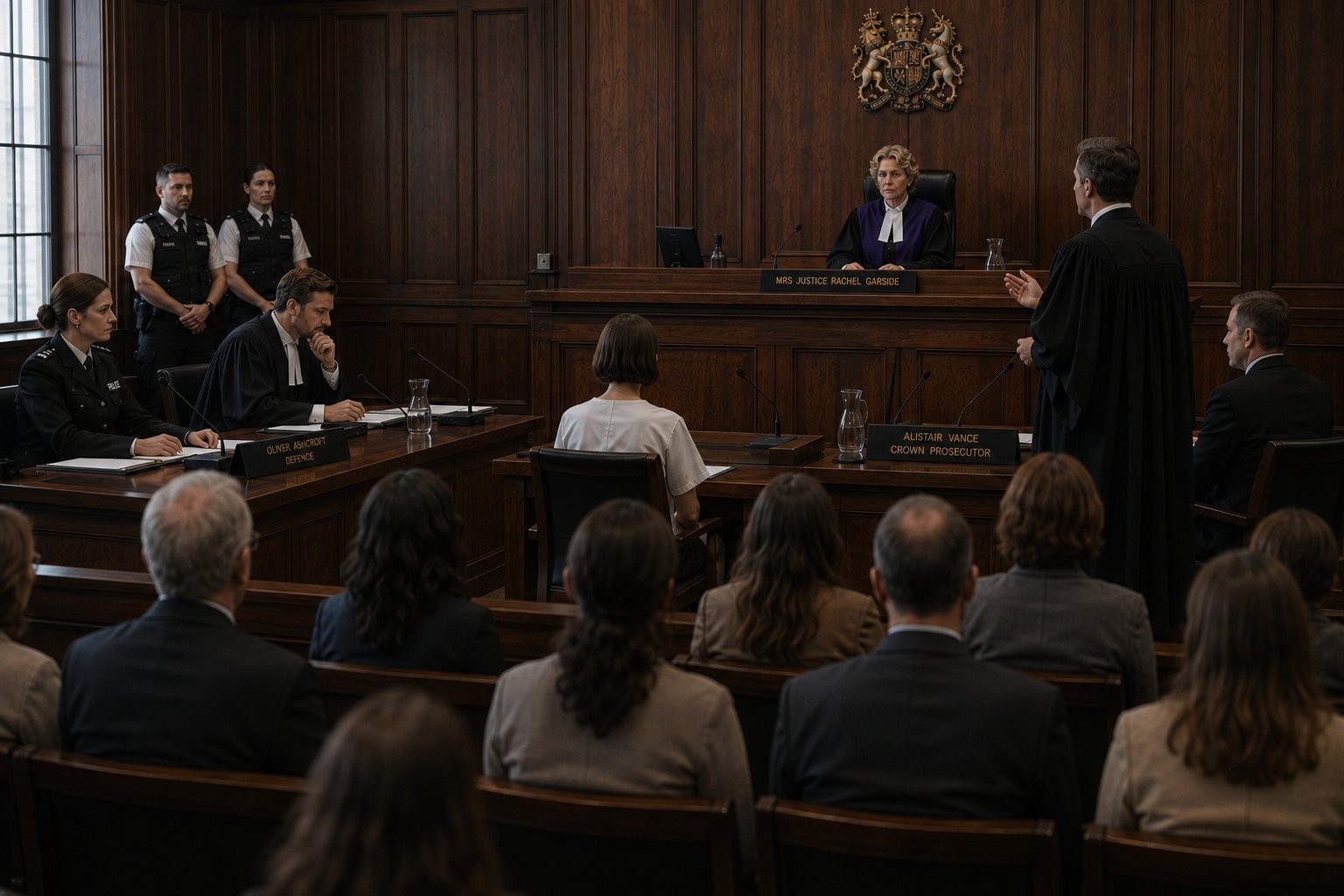
 The Old Bailey, London —
The murder trial of Beatrice Halloway has reached its dramatic conclusion at the Old Bailey, with a jury finding the 26-year-old guilty of the murder of James Glover following weeks of testimony, forensic evidence and a fiercely contested claim of self-defence.
The second week of proceedings began with perhaps the most personally damaging evidence yet heard by the jury: the testimony of Police Constable Walker, the first officer to arrive at Glover's residence on the night of his death.
Jurors watched footage taken from Walker's body-worn camera showing his initial encounter with Ms. Halloway. Appearing stunned and with blood visible on her clothing, Halloway can be heard telling the officer simply, "I killed him."
The courtroom remained nearly silent as the footage continued, with Walker subsequently entering the residence and discovering Glover.
Crown Prosecutor Alistair Vance argued that the footage represented an admission made before Halloway had been arrested, interviewed by detectives or consulted with a solicitor.
During cross-examination, however, Senior Barrister Oliver Ashcroft challenged the Crown's characterization of those four words.
"You would agree, Officer Walker, that my client never said, 'I murdered him'?" Ashcroft asked.
"No," Walker replied.
"She never said she planned to kill him?"
"No."
"She said she killed him?"
"Yes."
Ashcroft then turned towards the jury.
"Something she has never once denied."
The exchange encapsulated what would become the central question of the final days of the trial. Both sides agreed that Beatrice Halloway killed James Glover. The dispute was whether she murdered him or killed him while defending herself.
Several witnesses subsequently described Glover as an intimidating and at times volatile man, giving the defence ammunition for its argument that Halloway had legitimate reason to fear him. Character witnesses called on Halloway's behalf similarly described her as quiet, reserved and unlikely to initiate violence.
But the most anticipated witness was Halloway herself.
Taking the stand in her own defence, Halloway told jurors that an argument with Glover escalated into a physical confrontation and that she genuinely believed she was in danger. She admitted taking possession of the knife and acknowledged delivering the single stab wound that penetrated Glover's heart.
"I didn't go there to kill James," Halloway testified. "I thought he was going to hurt me. I was scared. I reacted."
Mr. Ashcroft argued that the devastated condition of the room supported her account, pointing back to crime scene investigator Sarah Pembroke's earlier testimony that the physical evidence appeared consistent with a struggle.
Then came Mr. Vance.
In a methodical cross-examination lasting several hours, the Crown Prosecutor confronted Halloway with virtually every significant piece of forensic evidence presented during the trial.
Why was there no fresh bruising on Glover's hands or arms consistent with the alleged struggle?
Why was none of Glover's DNA recovered from beneath Halloway's fingernails?
Why did bloodstain evidence place her less than 30 centimetres from Glover as blood sprayed from the fatal wound?
And, most significantly, why had her telephone been used to search phrases concerning "stabbings," "where is the best place to stab the heart," and "how long does it take for someone to die after being stabbed in the heart" before Glover died from precisely such an injury?
Halloway maintained that the searches had been taken out of context and denied that they demonstrated an intention to kill Glover.
The answer appeared to do little to satisfy Mr. Vance.
In closing arguments, the Crown characterized the killing as an act of preparation rather than panic.
Vance reminded jurors that Halloway's fingerprints were identified as the most recent prints on the knife, that Glover's blood covered her clothing, and that her internet history appeared eerily predictive of the injury that would eventually kill him.
He concluded by returning to the first words Halloway spoke to police.
"Before the lawyers, before the forensic scientists, before the explanations and excuses, there were four words," Vance told the jury.
"'I killed him.'"
Mr. Ashcroft, however, reclaimed those same words during his closing argument.
"'I killed him.' Not 'I murdered him.' Not 'I planned it.' Not 'I wanted him dead,'" Ashcroft said. "The Crown has spent weeks proving something Beatrice Halloway admitted within minutes. What they must prove is that when she killed James Glover, she had no lawful justification for doing so."
The jury retired shortly after midday.
After approximately nine hours of deliberations spread across two days, the twelve jurors returned to a packed courtroom.
Asked whether they had reached a verdict upon which they were all agreed, the foreman answered that they had.
Guilty of Murder.
Halloway showed almost no visible reaction as the verdict was read, maintaining the same neutral expression that has characterized her appearance throughout the proceedings. Mr. Ashcroft briefly lowered his head before speaking quietly with his client.
Sentencing followed after submissions from both sides.
Mr. Vance urged Mrs. Justice Rachel Garside to impose the maximum penalty available, arguing that Halloway's internet searches demonstrated preparation and elevated the killing beyond a spontaneous act of violence.
Mr. Ashcroft pleaded for Halloway's life, emphasizing that only a single wound was inflicted, that substantial evidence suggested some form of confrontation occurred and that his client had remained at the scene and immediately acknowledged responsibility.
Mrs. Justice Garside acknowledged those mitigating circumstances but ultimately found that the evidence of preparation, particularly Halloway's digital history, outweighed them.
"James Glover was killed by your hand," Garside told Halloway. "The jury has rejected your contention that your actions were necessary to preserve your own life. I am satisfied that this killing was preceded by contemplation and preparation."
The courtroom fell silent as the judge pronounced sentence.
Death.
Ms. Halloway remained expressionless as she was led from the dock.
Outside the Old Bailey, Mr. Ashcroft confirmed that his legal team would immediately appeal both the conviction and sentence, maintaining that significant questions remain surrounding the circumstances of Glover's death and describing the death sentence as "grossly disproportionate."
Mr. Vance offered only a brief statement.
"Today, James Glover received justice."
For Beatrice Halloway, however, the courtroom battle may be finished, but the fight for her life has only begun.
I'm Kelly Chambers with News Now, reporting from the Old Bailey.