
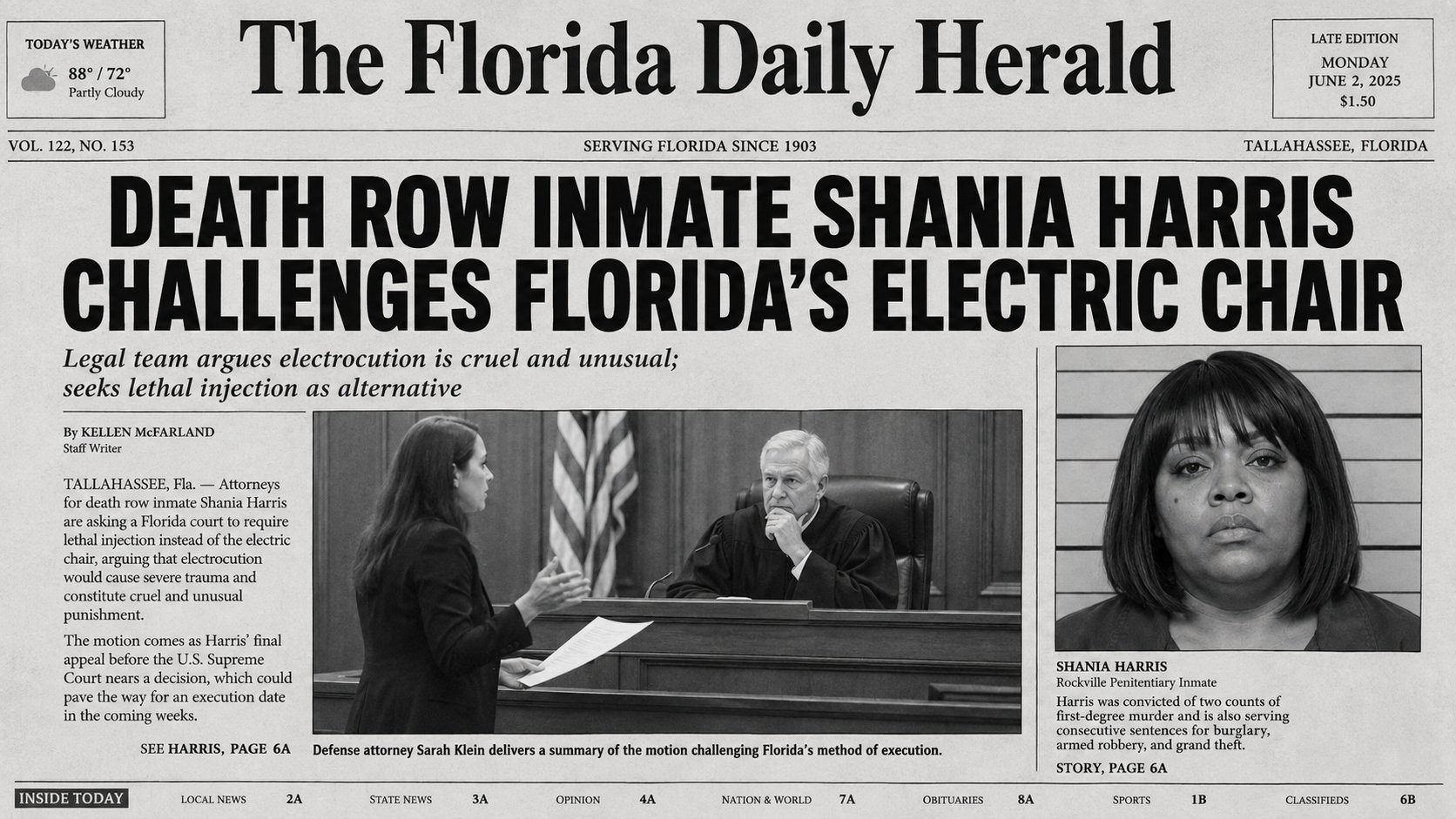
TALLAHASSEE, Fla. — Attorneys representing Florida death row inmate Shania Harris are preparing a new legal challenge to the state’s method of execution, arguing that forcing Harris to die in the electric chair would constitute cruel and unusual punishment and subject her to severe psychological trauma.
Harris, 39, was sentenced to death on August 1, 2022, after being convicted of two counts of first-degree murder. She also received consecutive prison sentences of six years for first-degree burglary, six years for armed robbery and four years for grand theft.
Her attorneys say the latest challenge comes as they await a decision on Harris’ final appeal before the U.S. Supreme Court. The defense believes that appeal could be rejected within the coming weeks, potentially clearing one of the last major legal obstacles standing between Harris and an execution date.
Rather than wait for that decision, Harris’ attorneys are attempting to get ahead of the process.
According to the defense, Harris has become increasingly terrified of being executed by electrocution and has experienced significant psychological distress over the possibility of being strapped into Florida’s electric chair.
Her attorneys intend to argue that, should Harris ultimately be executed, the state should be required to use lethal injection rather than electrocution.
The request could create an unusual legal problem for the state. Florida currently has no approved lethal-injection protocol applicable to Harris’ sentence, according to her attorneys. If a judge were to rule that electrocution cannot constitutionally be used in her case, the state could face additional litigation over whether — and how — an alternative execution procedure could be developed.
Prosecutors are expected to argue that Harris’ challenge is another attempt to delay a lawful sentence imposed more than four years ago.
Defense Points to Mercer Execution
Central to the defense strategy is the recent execution of Rebecca Mercer, whose death in the electric chair has renewed arguments over the physical effects of electrocution.
State officials maintain that Mercer’s execution proceeded according to protocol and have rejected suggestions that it was botched.
Witness accounts, however, have raised questions that Harris’ attorneys say deserve further examination. Some reports indicated that Mercer developed a nosebleed during the execution, with blood running down her face and eventually staining the front of her shirt.
Harris’ legal team is expected to cite those accounts as evidence that electrocution can inflict unnecessary physical injury beyond what is required to carry out a death sentence.
The state disputes that characterization. Officials have maintained that nothing observed during Mercer’s execution indicated that the equipment malfunctioned or that the procedure deviated from established protocol.
That disagreement could become a central issue if Harris’ challenge reaches an evidentiary hearing, where attorneys could seek testimony from execution officials, medical experts and witnesses to the Mercer execution.
Threatening Letters Add to Defense Claims
Harris’ attorneys are also raising concerns about their client's deteriorating emotional state while awaiting the outcome of her appeals.
According to the defense, Harris has received threatening and hostile letters from supporters of capital punishment, some containing graphic references to her eventual execution. Her attorneys say the correspondence, combined with the uncertainty surrounding her execution date, has caused Harris substantial mental anguish.
The defense is expected to argue that Harris’ fear of electrocution is not merely a generalized fear of death but an increasingly severe psychological reaction specifically associated with the electric chair.
Whether that argument carries constitutional weight remains uncertain. The state is likely to contend that emotional distress associated with an impending execution does not make an otherwise lawful method of capital punishment unconstitutional and that Harris cannot indefinitely postpone her sentence through successive challenges.
A Legal Strategy Before the Clock Starts
No execution date has been scheduled for Harris.
That is precisely why her attorneys are acting now.
If the Supreme Court declines to intervene, Florida officials could move quickly toward the next stage of the execution process. By filing a challenge to the electric chair beforehand, Harris’ defense hopes to ensure that questions surrounding the execution method are already before the courts rather than being raised only after a death warrant is issued.
A ruling in Harris’ favor would not overturn her murder convictions or death sentence. Instead, it could force Florida to determine whether it can legally execute her by another method.
For Harris, however, even a narrow ruling concerning the method of execution could have a much larger consequence: time.
Any requirement that the state establish a new lethal-injection procedure could lead to further hearings, appeals and constitutional challenges, potentially delaying Harris’ execution while those issues make their way through the courts.
For now, Harris remains on death row at Rockville Penitentiary, without a scheduled execution date, as two separate legal battles take shape — one challenging her death sentence itself and another challenging the method the state intends to use if that sentence is ultimately carried out.