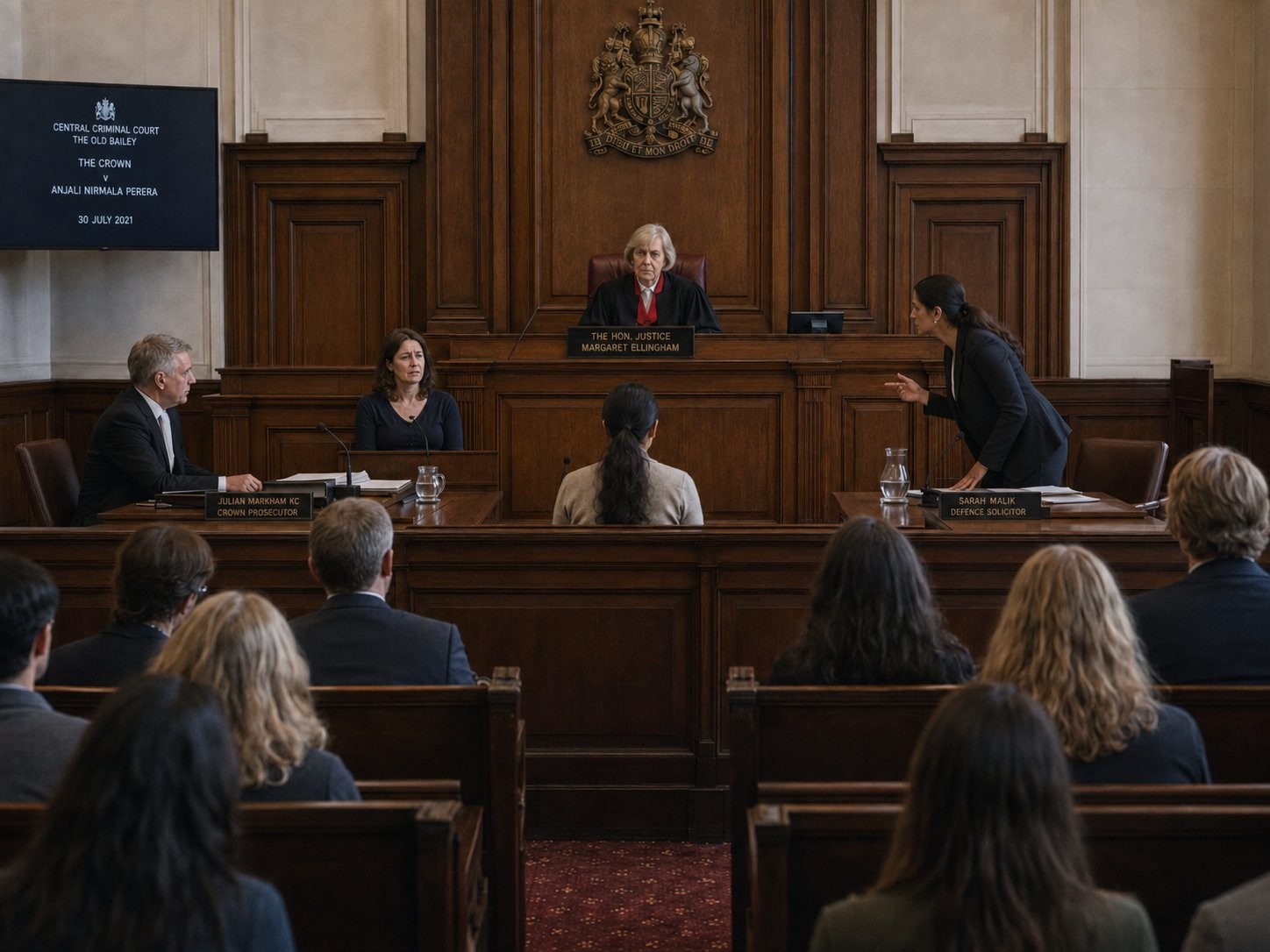
The Old Bailey, London:
Responsibility. That was the only word that mattered this week inside the Old Bailey, as the murder trial of Anjali Perera got underway. With the jury sworn in by Mrs. Justice Margaret Ellingham.
“Who was ultimately responsible for the deaths of Oliver and Sophie Carter? The prosecution will attempt to shift blame to the mother of Oliver and Sophie, Rebecca Carter. But the truth is, Anjali Perera is responsible, as she failed in her responsibility to properly take care of those two sweet innocent lives.” Those words were how Crown Prosecutor Julian Markham chose to open his comments to the jury, immediately laying the blame at the feet of Anjali Perera.
And while the question of who was responsible figure in this murder case was looming over the court, the responsibility of a fair and impartial trial was firmly in the hands of Justice Ellingham as she had to remind Mr. Markham during his opening remarks. “This was not an unavoidable accident. Two children were placed into the care of someone like Anjali Perera…..” “Mr. Markham I would advise you to have care in how you refer to the defendant, as she is to be treated with dignity and respect in this and any courtroom.” Justice Ellingham cautioned Mr. Markham.
Following Mr. Markham was Ms. Sarah Malik of the defense, standing before the jury, peering at them intently for several moments before finally speaking. “In a conventional trial, the most important pieces of evidence are what is factual. What can be proven to be true without a shadow of a doubt, with expert analysis and investigation. But this is not a conventional trial.” Ms. Malik conveyed to the jury. “There is no doubt Oliver and Sophie Carter drowned. That is one of the only indisputable facts, that ironically will do nothing for either side in this case.”
“The most important piece of evidence in THIS trial is going to be your intuition as jurors. How you respond to what is said, and shown to you over these next few days. Mr. Markham is going to do everything in his power to portray Anjali as dangerous, incompetent and someone who is incompatible with “Traditional English Values”. He is going to TRY and paint her as a murderer.”
“My job, and I am very good at my job, is to show the truth of who Anjali is. A kind, caring, and dedicated woman, who gave every ounce of being to caring for, not just Oliver and Sophie, but the entire Carter family. And that on that fateful day, Ms. Perera was not a murderer, but another victim in this accident. The Crown has to PROVE beyond a shadow of a doubt Anjali intentionally murdered Oliver and Sophie. My job is to put doubt into that theory.”
With opening comments to the jury concluded, the trial moved directly into witness and expert testimonies. The first of several expert witnesses were the basis for the foundation of this trial, with the first responding officer on the scene, the paramedic team and the forensic pathologist all giving into evidence the fundamental facts of the case.
Police Constable Thomas Mercer described the scene as he arrived, narrating over his own body camera footage, as he arrived, and called for medical personnel on scene. His own footage showed both the defendant and the mother of the children in hysterics at the sight of the children’s motionless bodies, which is the first piece of evidence to cast doubt onto the prosecution’s claims.
“Was there anything unusual that you witnessed while at the scene, Constable Mercer?” Posed Ms. Malik. “No. When I arrived, both the defendant and Mrs Carter were in the middle of attempting to pull both children from the pool. Mrs. Carter was visibly struggling, while the defendant almost had Oliver Carter out of the pool.”
“And you didn’t find Mrs. Carter’s struggles to pull her own child from the pool at all unusual Constable? Wouldn’t any person, let alone their mother, have such a sense of motivation to gather strength to pull a 50 pound child from a few feet of water?” While Ms. Malik’s question was one that relied on the personal opinion of the Constable, the question was clearly intended as one the jury was meant to weigh as part of the whole question of this trial.
Both the paramedic team and the forensic pathologist’s official statements both corroborated that the children died of drowning, and that the autopsies showed no signs of foul play, while the testimony of David Carter, husband to Rebecca and father to Oliver, Sophie and Emily, proved to be more neutral towards regarding the portrayal of Anjali. “I honestly didn’t interact with her too often. I travel for work, so Anjali spends more time in the house than I do. The handful of times I can honestly remember talking with her, she was polite, respectful, a bit…..blunt is the best way I can describe it. Our paths usually crossed when the children were already in bed, so I can’t honestly remember any interactions between her and the children.”
But it was the testimony of Rebecca Carter that both the prosecution and the defense viewed as the center piece of their strategy. Mr. Markham by all accounts was very passive with Ms. Carter, floating questions that were designed to pull at the strings of not just the Jury, but also Ms. Carter, with the intention of getting an emotional reaction out of her to show the jury that her grief is so honest and genuine that there was no question of her belief that she passed responsibility of her children to Anjali, and the repercussions of that decision would be haunting her for the rest of her life.
Yet, despite all the grandiose attempts by the defense and Ms. Carter to emotionally manipulate the jury, ever like an apex predator with the smell of blood in her mouth, Sarah Malik, a seasoned Criminal Defence Solicitor moved in to strike a massive wound into the Prosecutions argument. “You stated that you were laying in a lounge chair in your garden, which for the record, overlooks your pool. You stated that despite passing off responsibility of watching YOUR children to Anjali, YOUR children played in the garden, the same garden you were sitting in. If the children were so close by, why did you pass off the responsibility to watch them to the one person in the house, who had more responsibilities than just watching them?”
“I was tired. Yes the children were in the garden, but I was tired and felt distracted, so I told Anjali to watch them while they played.” Ms. Malik continued to press, despite Ms. Carter’s repeated assurances that she passed off responsibility for the kids to Anjali. “You were tired? I’m sure a stay at home mother with a full time Au-Pair in the house is very tiring Ms. Carter? Why were you so tired at roughly half past 1 in the afternoon? Did you do anything physically taxing that morning? Go for a run? Do you have a medical condition that results in periods of excess tiredness during the day? Do you get a full night's sleep every night? Do you drink alcohol?”
The rapid fire questioning did what it was supposed to do. It got under Rebecca Carter’s skin. With each answer of “No”, followed by another question immediately after, her attitude changed. The terseness with each subsequent answer grew. She started shifting in her seat. When the question of alcohol came up, she finally cracked. “NO! I don’t drink alcohol for God’s sake! My children are dead and you are asking if I drink alcohol!” A firm rebuke and reminder of court room conduct to Ms. Carter came from Justice Ellingham. The defense, to much of the courtroom’s surprise, ended questioning at that point.
To an untrained eye, it would seem a curious move, that Ms. Malik is letting a flustered and compromised key witness off the stand at a time when she should continue pressing. But my eye was trained directly on Sarah Malik as she stepped away from questioning Rebecca Carter, and back to the defense table, taking her place next to her client. There are layers to a high profile murder trial. And only the best litigators know how to peel back the layers at just the right moment to reveal the most damning evidence when it will do the most damage. Ms. Sarah Malik knows what layer she wants to reveal, and when, and it will be one that has a massive impact on this trial.
Responsibility was the theme of this article much as it was the theme of the early portions of this trial. But themes never last. As we continue to follow the trial of Anjali Nirmal Perera, we will see how the theme shifts from “Responsibility” to “Doubt”. I am Eleanor Tribby, Senior Court Correspondent for The London Chronicle.