
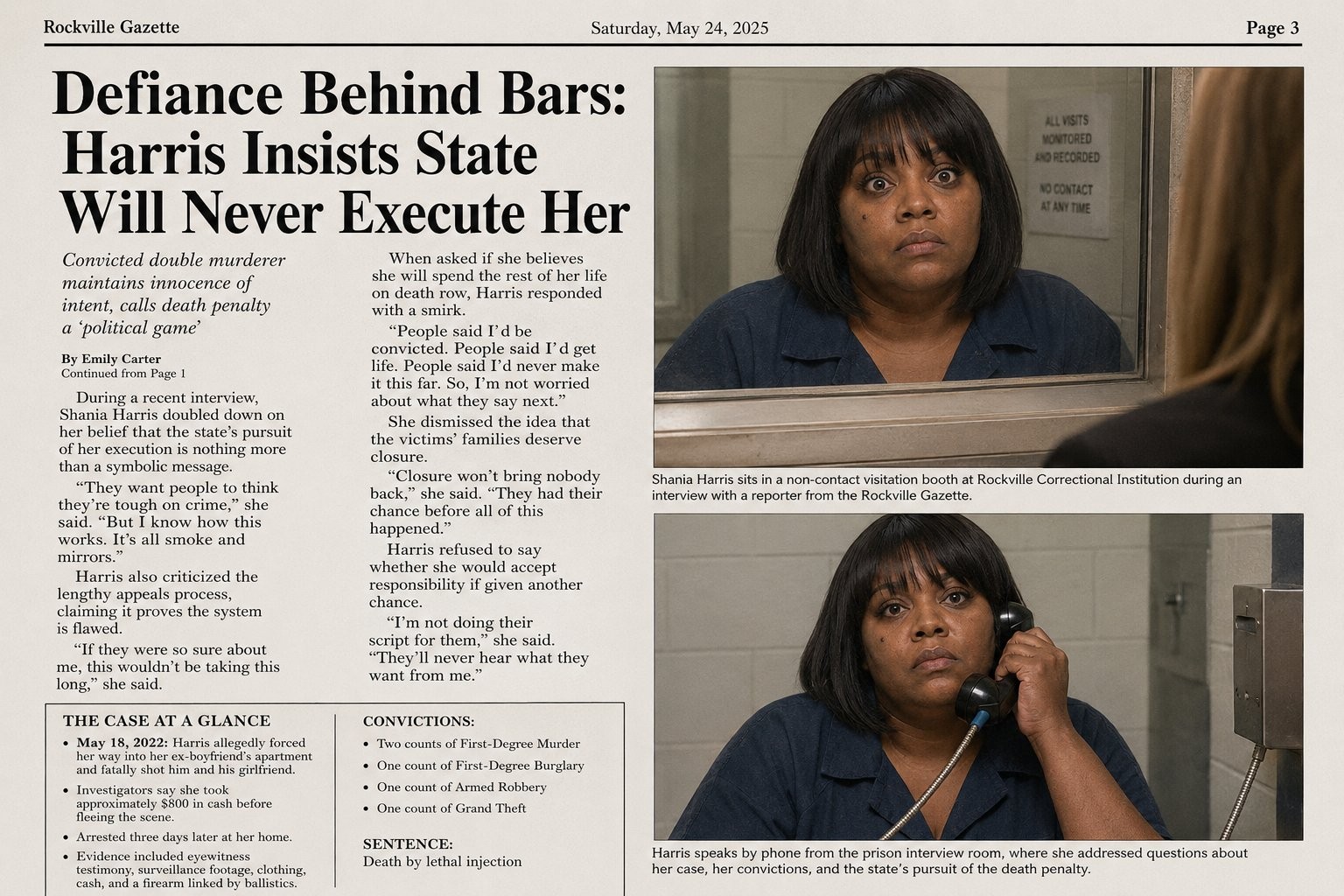
ROCKVILLE — Nearly four years after the fatal shootings that stunned the Rockville community, convicted double murderer Shania Harris remains unapologetic as she awaits execution at Rockville Correctional Institution's death row unit.
Harris was convicted of murdering her former boyfriend and his new girlfriend during a violent confrontation at the couple's apartment. Prosecutors argued she forced her way into the residence before shooting both victims at close range, later stealing approximately $800 in cash before fleeing the scene.
Investigators ultimately tied Harris to the crime through eyewitness testimony, surveillance footage, ballistics evidence, and items recovered during a search of her home.
Despite the convictions, Harris continues to insist that the state's pursuit of her execution is unjust.
"They're Not Going to Break Me."
Speaking during a monitored interview conducted inside the prison, Harris appeared calm and occasionally dismissive of her situation.
"They can keep talking about justice all they want," Harris said. "I've been sitting here for years, and nothing's happened. They think they're going to scare me? They're not."
Asked whether she felt remorse for the deaths, Harris paused before shrugging.
"People act like they know what happened that night," she said. "Everybody's got an opinion, but nobody was living my life."
When questioned about the victims' families, Harris offered little reflection.
"I can't change what's already happened," she said. "Sitting here crying isn't going to bring anybody back."
She also expressed confidence that her execution would never be carried out.
"These cases drag on forever," Harris said. "Appeals, lawyers, paperwork... they'll be arguing about this long after everybody forgets my name."
When reminded that two people lost their lives, Harris remained largely unmoved.
"The system wants me to be their example," she said. "That's what this is really about."
State: "Justice Is Deliberate, Not Forgotten."
Officials with the Rockville District Attorney's Office rejected Harris's characterization of the case, describing the murders as a calculated act of revenge.
"This was not a crime committed in confusion or self-defense," a spokesperson for the prosecutor's office said in a written statement. "The evidence demonstrated that Ms. Harris intentionally went to the victims' residence, unlawfully entered the apartment, murdered two unarmed individuals, stole property from the scene, and fled."
The office emphasized that multiple independent pieces of evidence—including surveillance footage, eyewitness accounts, forensic ballistics, and physical evidence recovered during the investigation—supported the jury's verdict.
"The victims were denied the opportunity to live the rest of their lives because of deliberate choices made by the defendant," the statement continued. "Our responsibility is to uphold the verdict reached by the jury and pursue the lawful sentence imposed by the court."
Families Continue to Mourn
Relatives of the victims have largely avoided public attention since the trial but have consistently urged the courts to uphold Harris's conviction.
In victim impact statements presented during sentencing, family members described the lasting emotional toll of losing two loved ones in a single act of violence. Several spoke of birthdays, holidays, and family milestones forever altered by the events of May 18.
Advocates working with surviving relatives said the legal process has been lengthy but necessary.
"They are not looking for revenge," one victims' advocate said. "They are looking for accountability under the law."
A Continuing Legal Process
Like most capital cases, Harris's conviction remains subject to years of appellate review. Those proceedings are designed to ensure that constitutional protections were observed throughout the investigation, trial, and sentencing process.
While Harris maintains that the state will never carry out her sentence, prosecutors say the passage of time does not diminish either the verdict or their commitment to enforcing the law.
For now, Harris remains housed on death row, where she continues to pursue appeals while insisting she has little concern about the outcome.
Outside the prison walls, however, prosecutors maintain that the case is not about Harris's confidence or defiance—but about the deliberate killing of two people whose lives ended in a single evening of violence.
As one prosecutor summarized, "Justice can take time. That does not mean justice has been abandoned."