
The heat that day was biblical—102 degrees with a humidity that made the air feel like wet wool. Iris Faye Baxter remembered thinking, as she buckled three-year-old Ruby into her car seat, that she should have worn a lighter blouse. She'd been up since 5 AM with a teething child, had worked a double shift at the diner the day before, and had exactly four hours of sleep in her system.
Ruby had been fussy. Crying about the heat, crying about her ears, crying about the butterfly sticker that had peeled off her water bottle. Iris sang "You Are My Sunshine" off-key, the way she always did, and Ruby eventually quieted, her lashes heavy, her little hand still clutching the tattered corner of her baby blanket.
At the grocery store parking lot, Iris's phone rang. It was her landlord, Mr. Cheney, threatening eviction. She was three weeks late on rent. The air conditioning in her apartment had broken, and Ruby's asthma had been flaring, and the repairman wanted $400 she didn't have. She parked. She unbuckled herself. She was already on the phone, already crying, already begging Mr. Cheney for one more week, just one more week, please, sir, I'll have it, I promise.
She walked into the Piggly Wiggly. She bought milk. Bread. Children's ibuprofen. A single pack of strawberries because Ruby loved strawberries, and they were on sale, and Iris wanted to give her daughter something good. She checked out. She walked to her car. She opened the back door.
Ruby was still buckled in. Still clutching her blanket. Still wearing the little sundress with the yellow daisies that Iris had bought secondhand from Goodwill for three dollars. Her skin was the color of a sunset. Her lips were blue. Her eyes were closed, and she looked peaceful, like she was just taking a nap after a long, hot day of being three years old.

Iris Faye Baxter did not scream. She did not cry. She stood there, in the parking lot of the Piggly Wiggly, with a bag of strawberries in one hand, and she made a sound that didn't come from any human vocabulary. It was the sound of a woman whose entire universe had just collapsed into a singularity. She dropped the strawberries. They rolled across the asphalt, red and ruined. She pulled Ruby out of the car seat and held her, pressing her lips to Ruby's forehead, the heat shocking her, the heat that had been cooking her daughter for forty-seven minutes while she argued with a landlord about money.
"Wake up," she whispered. "Baby, wake up. Mama's sorry. Mama's so sorry."
A stranger found her on the asphalt. He called 911. He tried to take Ruby from her arms, but Iris wouldn't let go. She held her daughter until the paramedics came, until they pried her away, until they put Ruby on a gurney and started CPR. Iris knew, in her bones, that Ruby was already gone. She knew it, and she knew she would never forgive herself, and she knew—with a terrible certainty—that she deserved whatever came next.

Three days later, DA Harrison C. Wade stood in her living room. He was up for re-election in November, and his polls were slipping. He looked around at the poverty, the peeling wallpaper, the broken fan, and his lip curled with disgust. He didn't see a grieving mother. He saw a golden ticket. "Mrs. Iris Faye Baxter," he announced, holding up a manila folder, "you are hereby charged with capital murder in the death of your daughter, Ruby June Baxter."
Iris didn't react. She hadn't eaten in days. She hadn't showered. She'd been staring at Ruby's empty toddler bed, at the stuffed rabbit that still smelled like her daughter's hair. "I was paying my landlord," she whispered. "I was trying to keep a roof over her head."
"Save it for the jury, Ms. Baxter." He spat the Ms. like an insult, emphasizing that she was unwed, a single mother, a woman who had failed in the most fundamental way a woman could fail. "You're going to die for what you did."
He had no evidence of malice. No history of abuse. CPS had never been called. Her neighbors, her coworkers, her mother—everyone who knew Iris described her as kind, gentle, a wonderful mother who would never hurt a fly. But DA Wade didn't care. He needed a villain. He needed the voters of Meridian County to see him as the man who locked up the "baby killer."
The trial was a circus. The local news ran the story every night: "Hot Car Death: Mother on Trial for Capital Murder." Iris sat at the defense table in a blouse that was too big for her, her collarbones jutting out like wings. Her public defender, Leonard Fisk, was a tired, overworked man with nicotine stains on his fingers. He knew it was a longshot. "She's innocent of capital murder," he said in his opening statement. "Iris Baxter is guilty of something far more common: exhaustion. Poverty. Despair. She made a mistake—a terrible, unforgivable, life-shattering mistake. But it was not murder. It was a mother who loved her child and lost everything in a single moment of forgetfulness."
DA Wade thundered back. "Ladies and gentlemen, Iris Faye Baxter strapped her three-year-old daughter into a car seat on a 102-degree day. She drove to a grocery store. She got out. She walked inside. She bought strawberries—strawberries!—while her baby baked to death. She did not remember her daughter for forty-seven minutes. In that time, Ruby Baxter's internal temperature reached 107 degrees. She suffered. She burned. She died alone, terrified, in the only place she should have been safe: her mother's car. There is no excuse. There is no forgiveness. There is only justice."
The witnesses came one by one. Mr. Cheney testified about the rent. Delores, Iris's mother, took the stand in a floral dress from a thrift store. "Iris is the kindest person I know," she said, her voice trembling. "She would give you the shirt off her back. She loved that little girl more than air. More than life." Under cross-examination, Wade cornered her. "Mrs. Baxter, did you ever know Iris to be forgetful?" "She's a single mother," Delores said, cracking. "She had so much on her mind." "Answer the question, please." "She forgot things. Yes. But never Ruby. Never her baby." "Until she did." Delores broke down on the stand, and Judge Arthur P. Hargrove—another man up for re-election, who had already made public comments about "reckless mothers"—told her to compose herself.
The character witnesses came next. Coworkers from the diner. Neighbors. The pastor from the small Baptist church. Each one said the same thing: Iris was a good person. A gentle soul. A hard worker. She'd never hurt a soul. DA Wade dismissed them all. "Of course she was nice to you. Murderers always are."
The jury deliberated for seven hours. Iris sat in a holding cell, clutching the cross necklace her mother had given her, praying to a God she wasn't sure existed anymore. She thought about Ruby. About the sound of her laugh. About the way she'd tug on Iris's sleeve and say, "Mama, mama, you my best friend." She thought about the last conversation they'd ever had: "Ruby, we're going to get strawberries, okay? You like strawberries." "I like them with sugar, Mama." "I know you do, baby. I'll put sugar on them." They never got the sugar.
The bailiff escorted her back. The jury filed in. They wouldn't look at her. "On the charge of capital murder," the foreman said, his voice shaking, "we the jury find the defendant guilty." Iris closed her eyes.
At sentencing, DA Wade petitioned for death. "The state of Mississippi has a duty to protect its most vulnerable citizens. Ruby Baxter was vulnerable. She relied entirely on her mother for protection, and her mother failed her in the most catastrophic way possible. This was not a mistake. This was negligence so profound, so willful, so cruel, that it rises to the level of depraved indifference. The only just sentence is death."
Leonard Fisk argued for life. He brought in a psychologist. He brought in Iris's mother again. He brought in the pastor. He talked about poverty, exhaustion, depression, the lack of support. "This woman has already been punished more than any courtroom can ever punish her. She will carry Ruby's death with her every single day for the rest of her life. She does not deserve to die for a mistake. She deserves mercy."
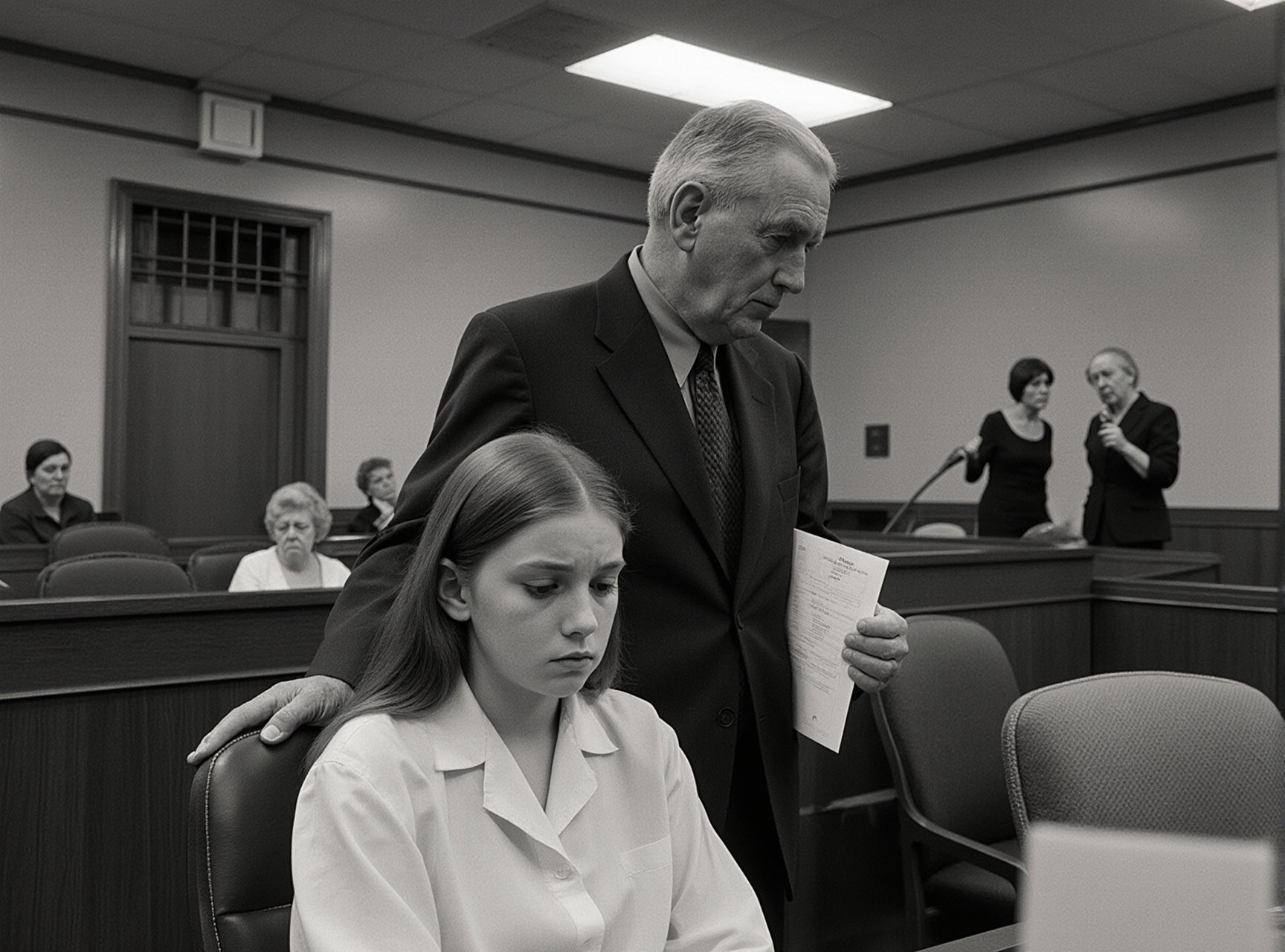
Judge Hargrove looked down at Iris. His face was impassive. "In the state of Mississippi, we do not treat the death of a child lightly. Ruby Baxter was three years old. She was innocent. She had her whole life ahead of her. And it was cut short because her mother decided that a phone call was more important than her daughter's safety. I find no mitigating circumstances sufficient to outweigh the gravity of this crime. I sentence you, Iris Faye Baxter, to death by lethal injection. You will be remanded to the TC Denton Correctional Center, where you will await execution on a date to be determined by the Governor."
Iris felt her legs go out from under her. Her mother screamed from the gallery. One word, over and over: "Iris! Iris! Iris!"
Six months later, Iris sat in a gray cinderblock cell on death row at TC Denton Correctional Center. Eight feet by twelve feet. A metal toilet. A thin mattress. The place was old, built in the 1950s, with peeling paint and a smell of bleach and despair that never quite went away. She had received thousands of letters—some calling her a monster, some calling her a martyr—and she had read none of them. She'd lost more weight. Her collarbones jutted out like wings. She barely ate. She barely slept. She had become a skeleton with skin stretched over it, a ghost haunting her own life.
Her mother visited every week. Delores would sit on the other side of the plexiglass, holding the phone, crying. "I'm going to save you, baby. I'm going to get you a new lawyer. I'm going to appeal. I'm going to talk to the Governor." "Mama," Iris would say, her voice flat, "stop." "I won't stop. I'll never stop. You didn't kill Ruby. It was an accident. It was a terrible, horrible accident." "I do deserve it," Iris said. And Delores would break down, and Iris would sit there, staring through her mother, already dead inside.
Leonard Fisk filed appeal after appeal. They were all denied. The Mississippi Supreme Court upheld the conviction. The U.S. Supreme Court declined to hear the case. The Governor, a conservative who had promised to be "tough on crime," refused to grant clemency. "Ruby Baxter was a child," the Governor said in a press conference. "She died in agony. Iris Baxter must face the consequences of her actions."
The media had a field day. Some painted Iris as a monster. Others painted her as a victim of a broken system, a poor woman railroaded by an ambitious DA and a judge looking to score political points. But two things were true: Iris Faye Baxter was not a monster—everyone who knew her described her as kind, gentle, compassionate, the kind of woman who fed stray cats and checked on elderly neighbors and sang lullabies to her daughter every night. And Iris Faye Baxter had killed her daughter. That fact was unchangeable. That fact would haunt her forever, even if she were pardoned, even if she lived to be a hundred.

The execution was scheduled for July 14th. Exactly thirteen months after Ruby died. The night before, Iris was allowed a final visit. Her mother came. The pastor came. A few coworkers from the diner came—the ones who still believed in her, the ones who remembered how she'd let them cry on her shoulder, how she'd always brought in baked goods for everyone. They told her they loved her. They told her she was a good person. They told her Ruby was waiting for her in Heaven. Iris listened. She nodded. She didn't cry.
When they were gone, she lay on her thin mattress and stared at the ceiling. She thought about Ruby's laugh. Ruby's smile. The way she'd say, "Mama, you my best friend." She thought about the strawberries. The ones she'd bought, the ones that had rolled across the parking lot, the ones she'd never gotten to put sugar on. She thought about DA Wade, who had used her to get re-elected. She thought about Judge Hargrove, who had called her a monster to score political points. She thought about the Governor, who had refused clemency to look tough. She thought about the jury, the strangers who'd decided she deserved to die. She thought about a system that had looked at a poor, exhausted, grieving young mother and decided she was worth more dead than alive.
And then she thought about herself. Twenty-six years old. A mother. A woman who had made one mistake, one terrible mistake, and who was going to pay for it with her life. She closed her eyes. "Ruby," she whispered into the darkness. "Mama's coming soon."
DA Wade won his re-election by a landslide. Judge Hargrove was appointed to the state Supreme Court. The Governor got a standing ovation at his next rally. But Iris Faye Baxter—the kind, gentle, broken woman who had made a terrible mistake—sat in her cell at TC Denton Correctional Center, waiting for the dawn, waiting for the drugs, waiting to see her daughter again. Everyone who'd ever known her said she was a good person. Everyone said she didn't belong on death row. But she was there anyway, because the system needed a villain, and she was convenient, and she was poor, and she had no one powerful enough to save her.

On the morning of July 14th, they came for her at dawn. The walk to the execution chamber was short. Iris wore a blue gown. Her hands and ankles were cuffed. Her mother was on the other side of the glass, sobbing, held up by the pastor. Iris offered a small, sad smile—the first smile she'd given in months. She looked at the witnesses. She looked at the people who had condemned her. She thought of Ruby, and she walked forward, ready to meet whatever came next.